
“I Remember a White Quebec
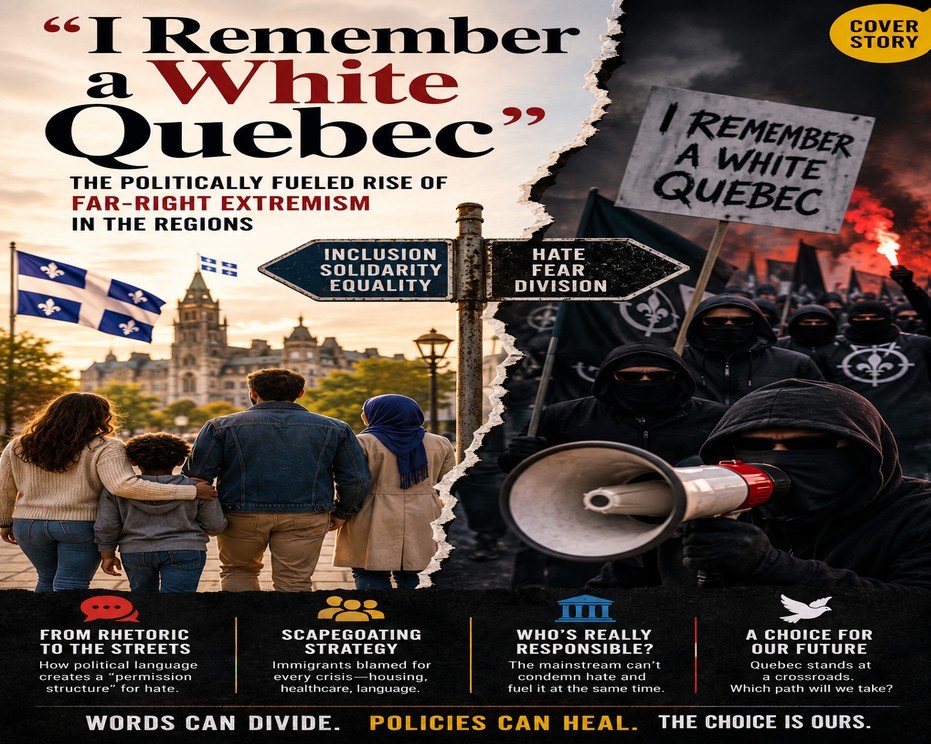
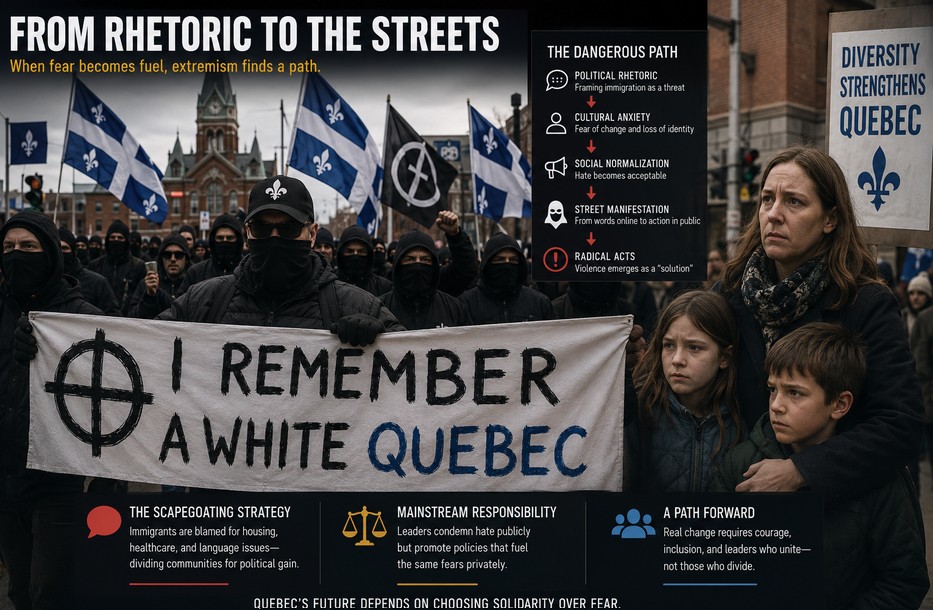

Public dissemination of such opinions in Quebec for years was restricted to the fringes of the Internet, anonymous. However, the sight of such a march in a mid-size regional city has caused a jolt to the province, and some sociologists and historians say that a reckoning for this has been a long time coming. This outcry of hatred did not come out of nowhere, experts warn, but rather was carefully orchestrated by politicians in Quebec City who were quick to demonize these groups as “marginal.” It is the culmination of a political environment that has been steadily clean swept of all but anti-immigrant scapegoating by the mainstream.
From Rhetoric to the Streets
From the online to the real world – from the town square – the pathway to a radical act is seldom sudden. A "permission structure" developed through years of political debates, in which legitimate questions about cultural integration and secularism have repeatedly been transformed into tales of existential threat, have been pointed to by historians.
According to Dr. Jean-François Lavoie, a historian of Quebec political movements, the current resurgence of far-right groups is closely tied to the language of mainstream political leaders, who are appealing to the region's voters.
“Having provincial politicians who constantly characterize immigration as a threat to the Quebecois identity, or who characterize the fact that visible minorities do exist in the regions as a 'cultural challenge', is like giving immigrants the raw materials from which extremist groups can be built. These groups do not work against the mainstream, they work in a space that has been vacated by mainstream politicians and deemed acceptable”.
The Scapegoating Strategy
The story of "replacement" has taken root in the regions, where demographic changes are more apparent to older, homogeneous groups. Political parties have unwittingly or wilfully "normalized" the notion that immigrants are the reason for the problems in the province—problems they have consistently put at the centre of discussion when it comes to housing, healthcare waiting times, and the shrinking French language.
The Shawinigan protest reflects this strategic political framing, says Mélanie Gagnon, a sociologist specializing in radicalization in rural Quebec.
“The banner is a symptom, not a cause, "Gagnon observes. “Every election cycle, when the political elite is debating whether some newcomers 'fit' into Quebec society, the message is loud to radical groups: who 'belongs' is still up for debate, and who can be intimidated or started by violence and make an exception?”
The Mainstream is responsible for the Responsibility
The public image of the “Shawinigan protest” has left the Quebec political scene under a lot of strain. Premier Christine Fréchette and other party leaders were quick to denounce the masked marchers, labelling the display "repugnant" and "unrepresentative of Quebec values.
But civil rights activists say this sort of condemnations are performative at best, and hypocritical at worst. They remind us that it is logical to denounce the expression of hate and yet to advance policies such as the harsh secularism bills or xenophobic immigration speeches that appeal to the same fears. Alain Babineau, head of police sector relations for the Red Coalition says the government simply can't have its cake and eat it too.
“Five years of warning the public that immigrants are a threat to our 'way of life,' and then getting "surprised" when people appear in masks to protect our 'way of life' with hate," Babineau says. It seems that the government has constructed the stage, and now finds no one has chosen to perform there”.
A Path Forward or a Deeper Divide?
It's easy to see that it's going to take more than just policing to turn around this tide, as local communities grapple with responding to this extremist show. It will take a complete paradigm shift in the provinces self-talk. Quebec's adherence to a form of nationalism that focuses on exclusion is likely to be the first of many incidents, experts predict.
The "permission structure" of hate has been set in place, and will only be broken through a cross-party, concerted effort. Until the politics of fear passes from the main stream politicians to acquire their suburban and regional majorities, the banner will continue to be a potent and dangerous instrument of where the province is going.
Conclusion
To complete this study of extremism in Quebec, it is important to summarize at this time the essence of the dilemma faced by the province. But far-right movements like Shawinigan are not a solitary occurrence but the inevitable consequence of an atmosphere where identity concerns and anxieties
have come to dominate over social solidarity and policy integration.
The key question to the future of Quebec's social harmony is one of political bravery. Provincial leaders who persist in the "politics of fear" are making short-term electoral wins more important than sustaining a healthy democracy over time. In any democracy, dissent and debate are essential, but when this debate becomes a weapon to demonize other fellow citizens as threatening the state's very existence, it is the perfect recipe for the rise of extremism.