
The Trophy Hunters of Station 39: Inside the Montreal Police Racism Scandal
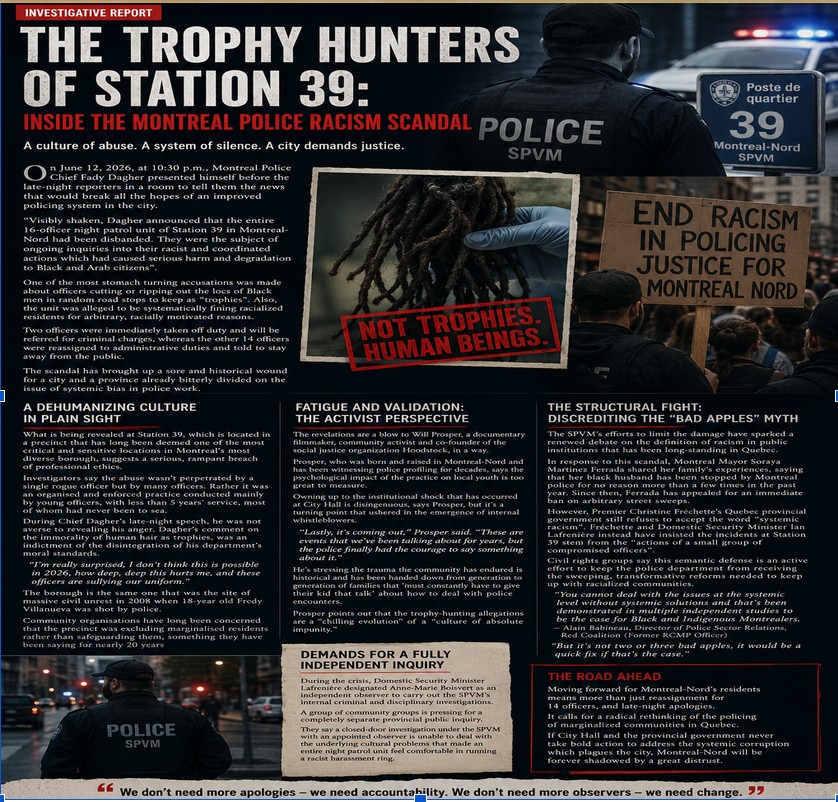
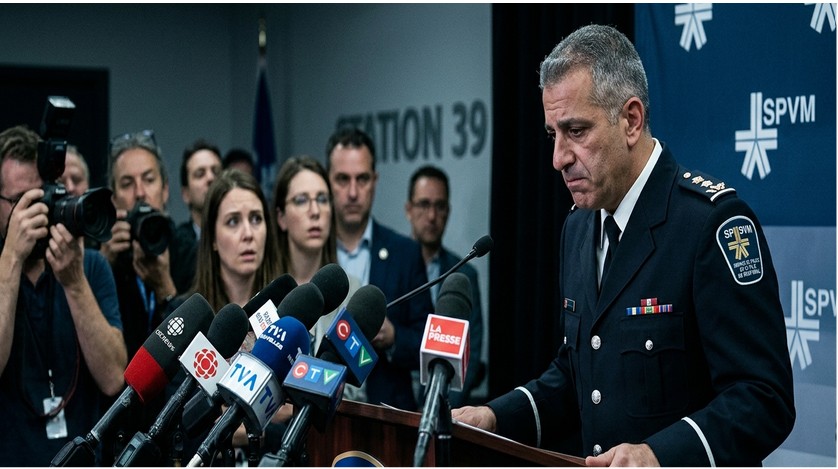
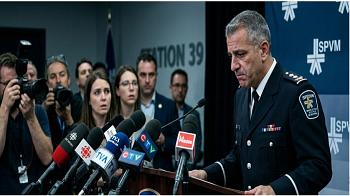

On June 12, 2026, at 10:30 p.m., Montreal Police Chief Fady Dagher presented himself before the late-night reporters in a room to tell them the news that would break all the hopes of an improved policing system in the city.
“Visibly shaken, Dagher announced that the entire 16-officer night patrol unit of Station 39 in Montreal-Nord had been disbanded. They were the subject of ongoing inquiries into their racist and coordinated actions which had caused serious harm and degradation to Black and Arab citizens”.
One of the most stomach turning accusations was made about officers cutting or ripping out the locs of Black men in random road stops to keep as "trophies. Also, the unit was alleged to be systematically fining racialized residents for arbitrary, racially motivated reasons. Two officers were immediately taken off duty and will be referred for criminal charges, whereas the other 14 officers were reassigned to administrative duties and told to stay away from the public. The scandal has brought up a sore and historical wound for a city and a province already bitterly divided on the issue of systemic bias in police work.
A Dehumanizing Culture in Plain Sight
What is being revealed at Station 39, which is located in a precinct that has long been deemed one of the most critical and sensitive locations in Montreal's most diverse borough, suggests a serious, rampant breach of professional ethics. Investigators say the abuse wasn't perpetrated by a single rogue officer but by many officers. Rather it was an organised and enforced practice conducted mainly by young officers, with less than 5 years’ service, most of whom had never been to sea.
During Chief Dagher's late-night speech, he was not averse to revealing his anger. Dagher's comment on the immorality of human hair as trophies, was an indictment of the disintegration of his department's moral standards.
“I'm really surprised, I don't think this is possible in 2026, how deep, deep this hurts me, and these officers are sullying our uniform. The borough is the same one that was the site of massive civil unrest in 2008 when 18-year old Fredy Villanueva was shot by police. Community organisations have long been concerned that the precinct was excluding marginalised residents rather than safeguarding them, something they have been saying for nearly 20 years”.
Fatigue and Validation are the themes of the Activist Perspective
The revelations are a blow to Will Prosper, a documentary filmmaker, community activist and co-founder of the social justice organization Hoodstock, in a way. Prosper, who was born and raised in Montreal-Nord and has been witnessing police profiling for decades, says the psychological impact of the practice on local youth is too great to measure.
Owning up to the institutional shock that has occurred at City Hall is disingenuous, says Prosper, but it's a turning point that ushered in the emergence of internal whistleblowers.
Lastly, it's coming out,” Prosper said. These are events that we've been talking about for years, but the police finally had the courage to say something about it. He's stressing the trauma the community has endured is historical and has been handed down from generation to generation of families that 'must constantly have to give their kid that talk' about how to deal with police encounters. Prosper points out that the trophy-hunting allegations are a "chilling evolution" of a "culture of absolute impunity.
The Structural Fight: A Discrediting of the "Bad Apples" Mythology
The SPVM's efforts to limit the damage have sparked a renewed debate on the definition of racism in public institutions that has been long-standing in Quebec. In response to this scandal, Montreal Mayor Soraya Martinez Ferrada shared her family's experiences, saying that her black husband has been stopped by Montreal police for no reason more than a few times in the past year. Since then, Ferrada has appealed for an immediate ban on arbitrary street sweeps.
However, Premier Christine Fréchette's Quebec provincial government still refuses to accept the word "systemic racism. Fréchette and Domestic Security Minister Ian Lafrenière instead have insisted the incidents at Station 39 stem from the "actions of a small group of compromised officers.
Civil rights groups say this semantic defense is an active effort to keep the police department from receiving the sweeping, transformative reforms needed to keep up with racialized communities. The Red Coalition's director of police sector relations, Alain Babineau, a former RCMP officer, doesn't want anyone to underestimate the size of the problem.
“Babineau said you cannot deal with the issues at the systemic level without systemic solutions and that's been demonstrated in multiple independent studies to be the case for Black and Indigenous Montrealers. But it's not two or three bad apples, it would be a quick fix if that's the case”.
Demands for a Fully Independent Inquiry
During the crisis, Domestic Security Minister Lafrenière designated Anne-Marie Boisvert as an independent observer to carry out the SPVM's internal criminal and disciplinary investigations.
A group of community groups is pressing for a completely separate provincial public inquiry. They say a closed-door investigation under the SPVM with an appointed observer is unable to deal with the underlying cultural problems that made an entire night patrol unit feel comfortable in running a racist harassment ring.
Moving forward for Montreal-Nord's residents means more than just reassignment for 14 officers, and late-night apologies. It calls for a radical rethinking of the policing of marginalized communities in Quebec. If City Hall and the provincial government never take a bold action to address the systemic corruption which plagues the city, Montreal-Nord will be forever shadowed by a great distrust.